
CDOT debuts Access Edgebrook redevelopment plan
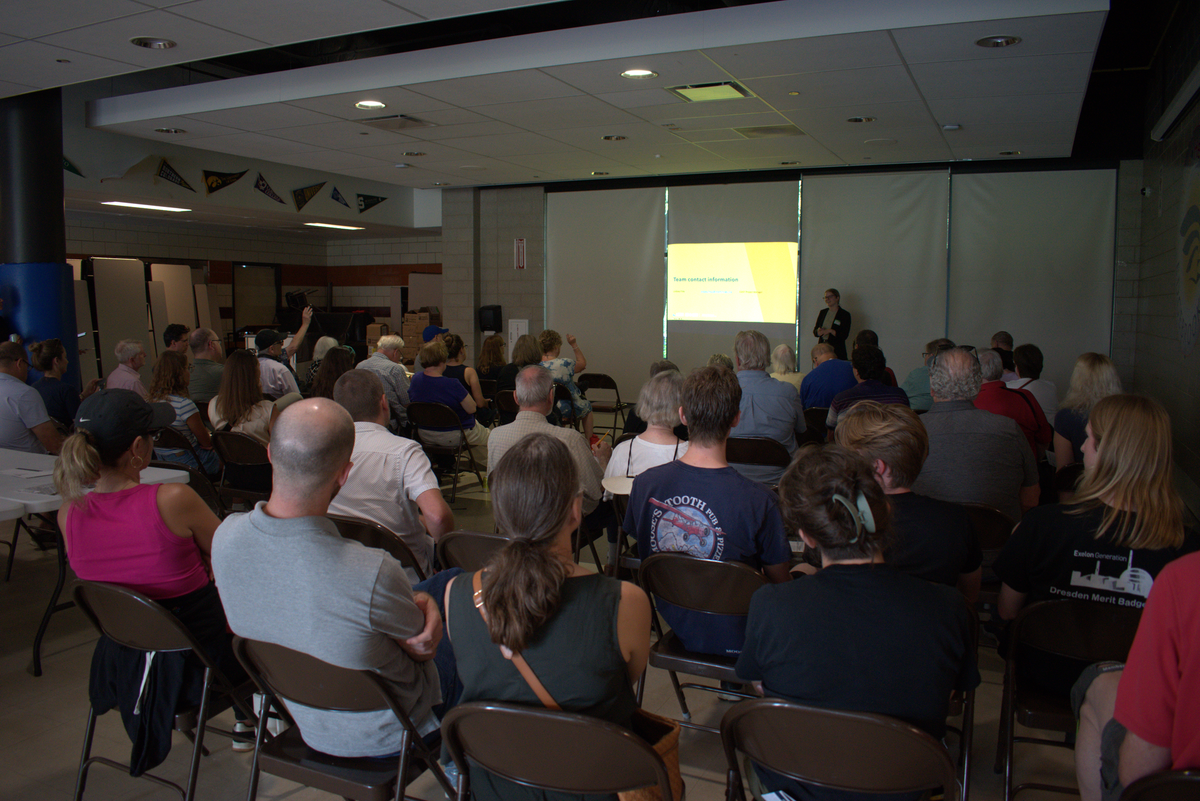
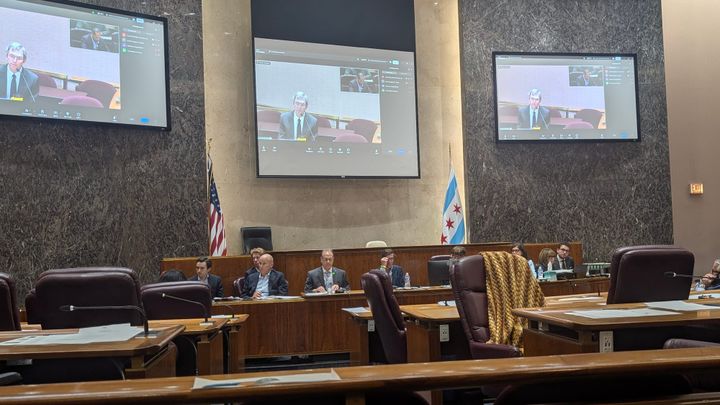
Neighbors gathered on Wednesday to hear and provide feedback on the initial stages of the Chicago Department of Transportation’s (CDOT) Access Edgebrook initiative. The meeting kicked off the reimagining project which is expected to take at least a decade from planning to completion.
Access Edgebrook aims to reconfigure the six intersections within 1/8 mile of another because of the intersections of Caldwell Ave, Devon Ave, Lehigh Ave, and Central Avenue. Railroad tracks used by Metra’s MD-N line and freight railway operators run parallel to Lehigh Ave.
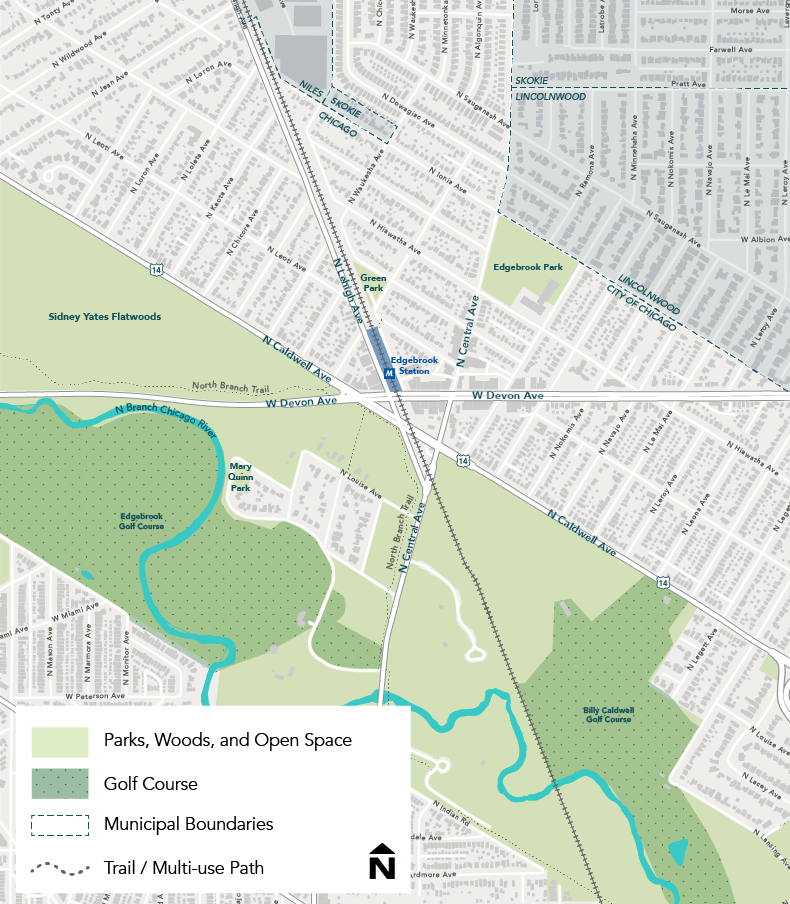
CDOT is conducting a Planning and Environmental Linkages (PEL) study paid for by the State of Illinois. A PEL study considers corridor planning and environmental impact in the same study. Planning and environmental impact studies are often completed separately. CDOT is using this study type because it expects to apply for federal funding given the significant scope of work needed to be completed. Agencies applying for federal infrastructure funding must complete an environmental review, as mandated by the National Environmental Protection Act (NEPA). The PEL allows CDOT to put some of the findings in the planning stages into the environmental review therefore cutting down the timeline for project implementation.
Current Design Issues and Solutions
The frequency of intersections and trains crossing Devon, Caldwell, and Central Avenues has led to 61-108 hours of combined daily delay for motorists.
This backup along with lengthy pedestrian crossings across Devon at Caldwell has created issues for all users of the road. Pedestrians using the crosswalk who depart too soon get trapped on a small median while vehicles fly by.
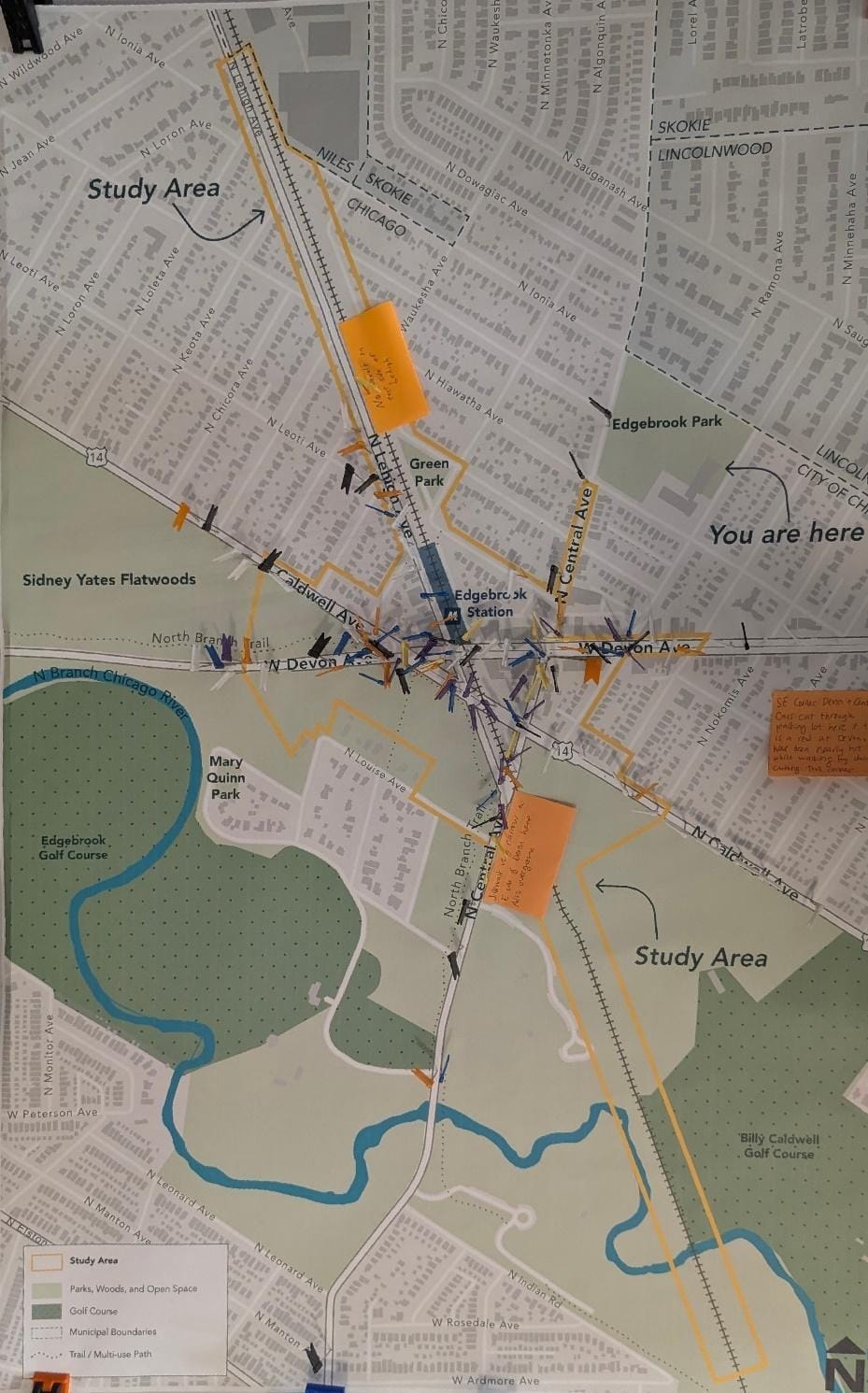
Residents provided a wide range of issues and solutions through interactive boards which allowed them to point to specific issues. On a posterboard showing an aerial view of the intersection layout, participants placed flags to show where they felt vehicles traveled too quickly (black), where bikers felt unsafe (orange), and where pedestrians found it hard to cross (yellow). All types of flags were placed at every intersection, underscoring the community’s barrier to navigation of this commercial district.
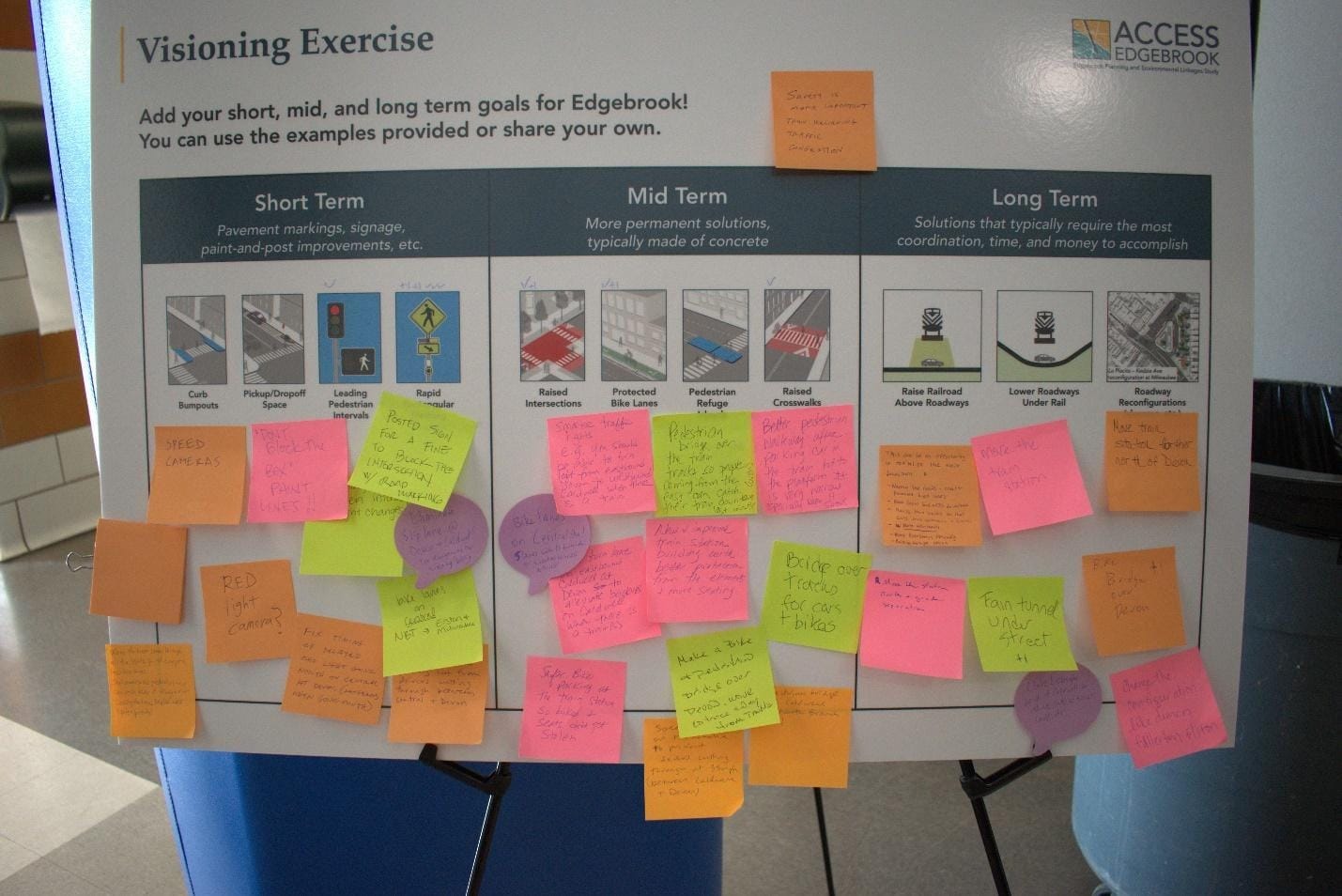
The expected 10-year process for improvement caused CDOT to break up improvements into phases. CDOT Project Lead Lindsey Frey relayed that “even if the project takes 10 years, why wait [to implement near-term solutions]?” For quicker adjustments, the DOT is looking at removing slip lanes and narrowing the crosswalk on Devon Ave. CDOT may also create pickup/dropoff space, create curb extensions, and modify pedestrian signal timing to provide a clear right of way.
Residents responded positively to these proposed changes, suggesting specific solutions such as protected bike lanes on Central Ave, retiming the delayed NB red light at Central/Devon, and speed cameras.
Mid-term improvements included pouring concrete to create raised intersections and crosswalks, protected bike lanes, and pedestrian refuge islands.
Long-term improvements could entail building a viaduct to elevate the train line or send traffic underground and significantly modify the roadway configuration. Ryan Richter, a coordinating planner at CDOT for rail and transit projects, noted a challenge in deciding the scale of improvements is that the study area only experiences high traffic volume for two hours of the day.
Opinions differed greatly on what long-term improvement should be made. Those wanting the train line to become a viaduct felt that it would infringe on the Devon Ave commercial district or otherwise be ugly. Those in favor of roadway reconfiguration suggested the configuration be similar to the Damen/Elston/Fullerton intersection.
A common suggestion was moving the train station north of Devon Ave, under the assumption that the boom barriers would not be activated and allow vehicle traffic to resume sooner. Boom barriers are activated when a train is within 20 seconds of a crossing, moving or not. The station would need to be moved much further north to Lehigh/Touhy for the gates to be lifted at Devon Ave.
Interagency coordination has been at the forefront of the discussion for CDOT. It has been and will continue working with IDOT and Metra who have agreed that all of the options presented by CDOT are on the table. The Forest Preserve of Cook County is another partner but is hesitant about some proposed improvements because some changes would involve land transfers away from them. Richter suggested that substituting land taken away by this project could be resolved by providing them with new land elsewhere in Cook County.
Next Steps
This was the first of several planned public meetings to collect feedback and CDOT is in the very early stages of planning. The PEL involves four stages: evaluating existing conditions, creating a purpose and need statement and naming alternatives, the alternatives analysis, and selecting an alternative for future phases. Wednesday’s public meeting came after evaluating existing conditions. CDOT will incorporate feedback from the meeting.
A second public meeting is planned to occur this fall once the alternatives analysis has been completed.
If you wish to submit feedback on this project but were unable to attend, you can provide feedback to Lindsey.Frey2@cityofchicago.org.
Comments ()