
CMAP Will Hold Aug. 6 Hearing on Regional Plan That Includes Lake Shore Drive Reconstruction
The hearing is one of the final opportunities for public input before the agency considers adopting its 2026 Regional Transportation Plan this fall.
The Chicago Metropolitan Agency for Planning will hold a public hearing this Thursday for its Regional Transportation Plan (RTP) that could affect how the proposed reconstruction of North DuSable Lake Shore Drive (NDLSD) moves forward and competes for federal funding.
The hearing on CMAP’s draft 2026 RTP is scheduled for 3 to 4:30 p.m. Aug. 6. Members of the public may attend in person at CMAP’s offices in the Old Post Office, 433 W. Van Buren St., Suite 450, or participate virtually. Advance registration is required.
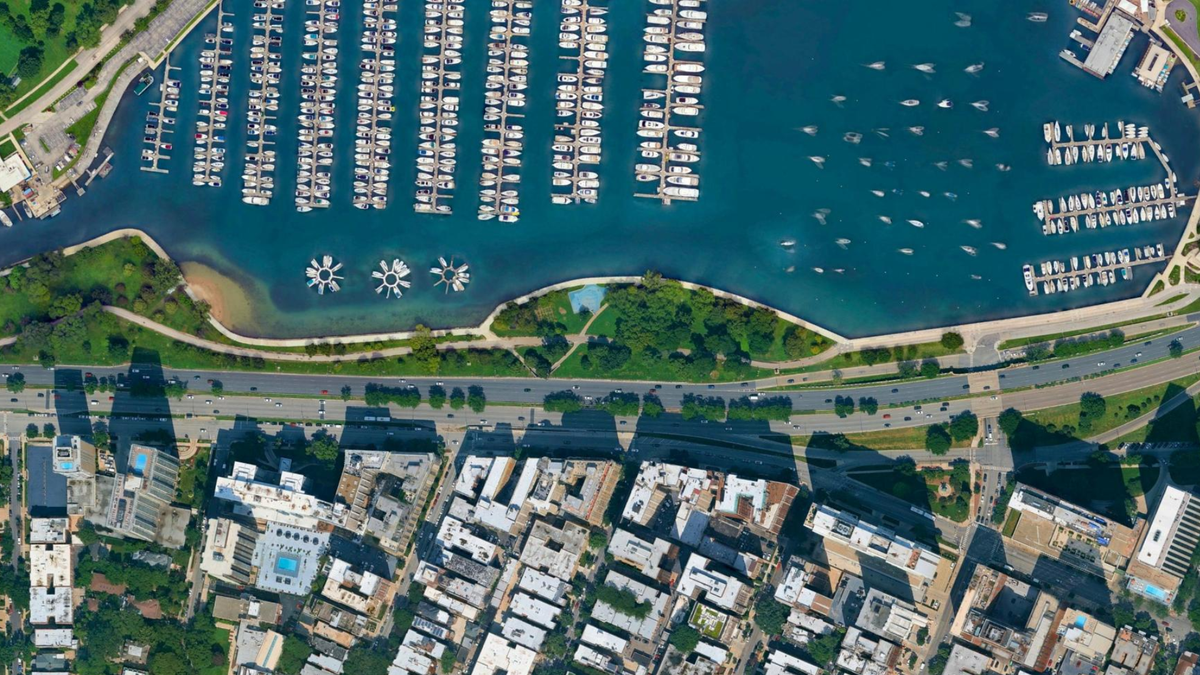
The hearing covers the full regional plan which sets long-term transportation priorities for northeastern Illinois.However, much of the public attention this year has focused on the status of NDLSD, a roughly seven-mile corridor between Grand and Hollywood avenues that carries cars, buses, and other traffic along the lakefront on the city’s north side..
The roadway’s bridges, pavement, ramps, and other infrastructure require significant rehabilitation or reconstruction. The dispute is not primarily over whether repairs are needed, but over what kind of transportation corridor should replace the aging infrastructure.
For more than a decade, the Illinois Department of Transportation and Chicago Department of Transportation have studied the corridor through a planning process known as Redefine the Drive. Residents, transit riders, drivers, park users, and advocacy groups have participated in meetings and surveys about roadway safety, bus service, pedestrian access, traffic congestion, and connections between nearby neighborhoods and the lakefront.
In 2024, IDOT and CDOT released a recommended preferred alternative that largely retained the Drive’s current eight-lane roadway configuration. The proposal also included redesigned interchanges, shoreline work, new or rebuilt pedestrian access points, and bus-priority treatments on some entrance and exit ramps. It did not include continuous bus-only lanes along the full corridor, which became a major point of disagreement.
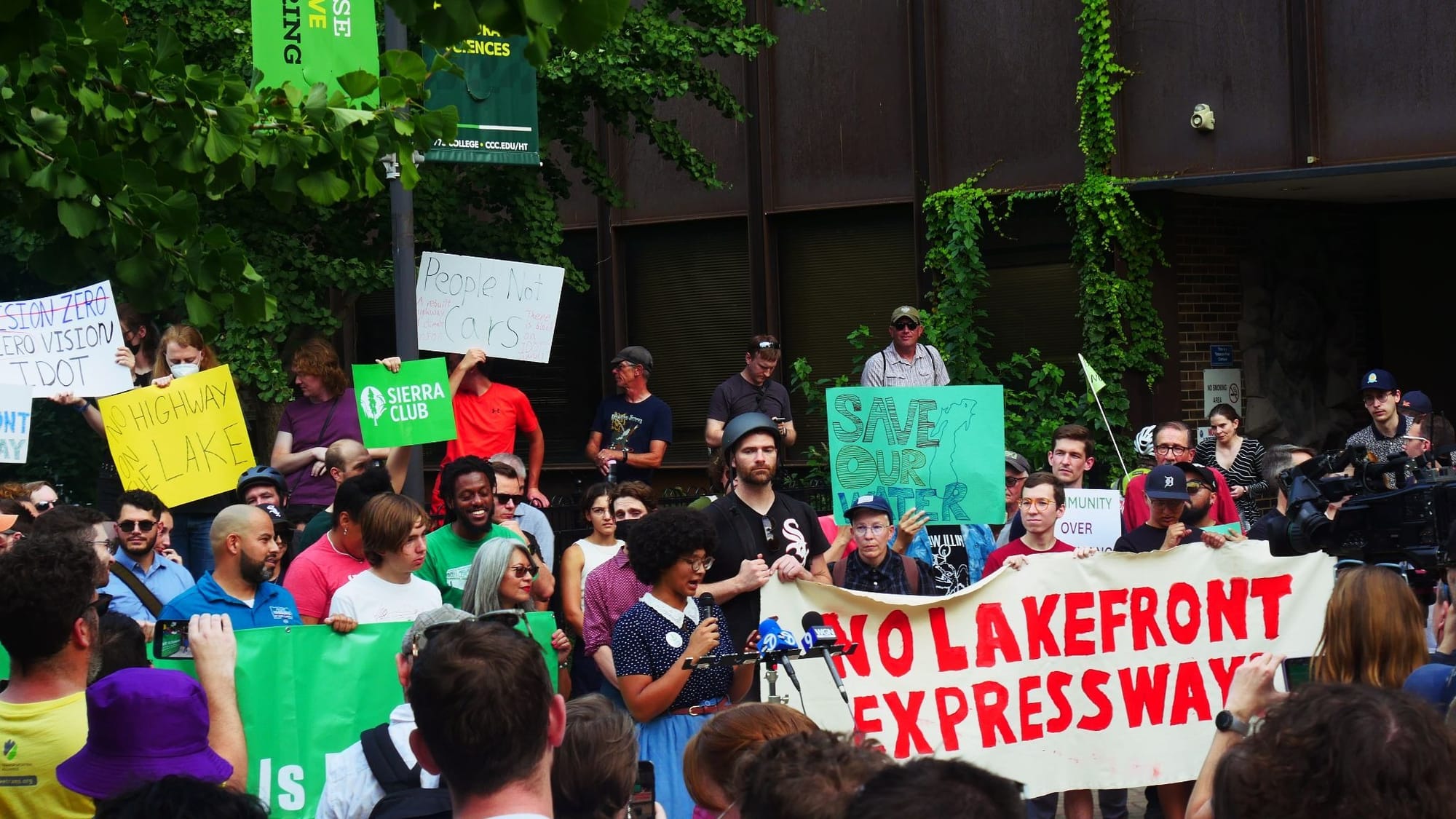
Some transportation advocates and elected officials called for the agencies to evaluate a lower-speed boulevard, fewer general-traffic lanes, and more extensive transit improvements. Other participants have emphasized the Drive’s importance as a regional roadway and warned that reducing vehicle capacity could increase congestion or divert traffic to neighborhood streets. The political response included House Resolution 438, passed by Illinois General Assembly in 2024, that called for the Drive to be transformed into a true boulevard with substantial transit investment and better access to the lakefront. Because it was a resolution rather than a law directing the project agencies, it expressed the legislature’s position but do not require IDOT or CDOT to adopt a particular design. CMAP later cited the resolution in its own summary of the public comments it received.
Following the response to the 2024 proposal, IDOT and CDOT began revisiting the alternatives analysis using updated modeling data. CMAP has said that no preferred alternative has been selected or finalized and that the public will have additional opportunities to comment once the agencies develop a new recommendation. That project-level review is separate from the regional planning process now underway at CMAP.
As the federally designated metropolitan planning organization for northeastern Illinois, CMAP is responsible for developing a long-range transportation plan that identifies projects considered consistent with the region’s goals and reasonably anticipated revenues. The draft RTP lists the NDLSD project as both a priority investment and a fiscally constrained regional capital project. The priority investments are listed alphabetically and are not ranked by importance or expected construction order.
A project’s inclusion on the fiscally constrained list does not select its design, authorize construction, or guarantee that it will receive funding. Those decisions remain with the sponsoring agencies through environmental review, engineering, and other project-development processes. It does, however, preserve the project’s eligibility to compete for federal transportation money and obtain certain federal approvals.
CMAP has said it recommends retaining NDLSD on the constrained list because the corridor has a documented state-of-good-repair need and because removing it could reduce the agencies’ ability to seek federal funding for reconstruction. That distinction has been central to the debate at CMAP meetings this year.
CMAP’s draft plan describes fiscally constrained projects as eligible for federal funds, and some advocates have argued that keeping the project fiscally constrained could allow the earlier highway-oriented proposal to continue moving through the funding process before its replacement has been fully defined. They have asked CMAP to classify the project as visionary, a category used for projects that remain early or exploratory and require additional study. Visionary and illustrative projects are classified as unconstrained because they require further study or do not yet contain enough detail to be included within the region’s expected revenues.
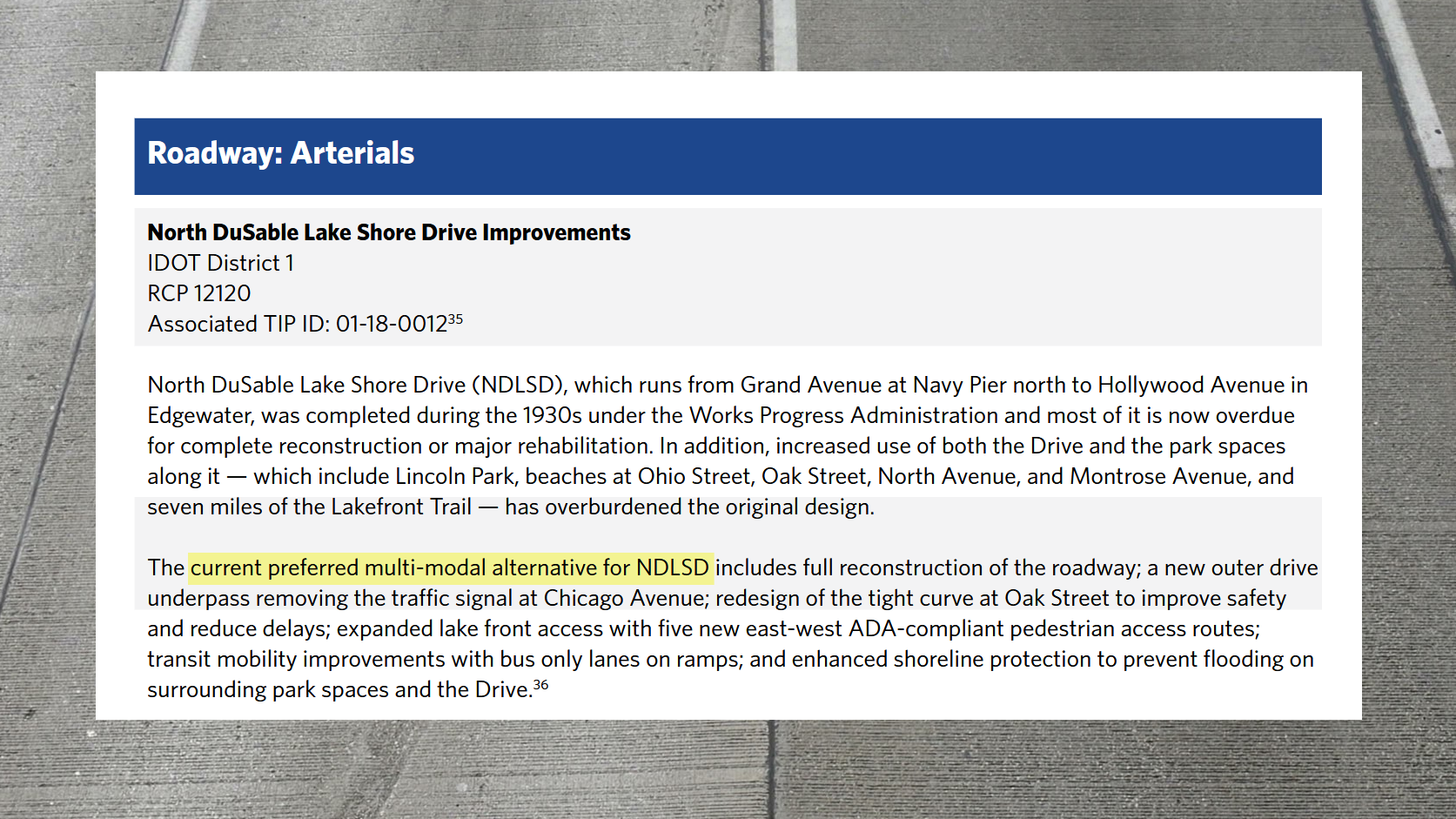
Public commenters have also raised questions about how the project is described in the plan’s appendices. Although CMAP and the project website say no preferred alternative is final, advocates have pointed to language in the Regional Capital Projects Benefits Report describing a preferred multimodal alternative. They are asking CMAP to revise the wording so the final document reflects the project’s current status.
CMAP has maintained that keeping the project on the constrained and priority lists does not endorse the 2024 design or prevent IDOT and CDOT from selecting a boulevard, additional transit treatments, or other changes through the renewed alternatives process.
Public interest in that distinction has been unusually high. For CMAP’s February meeting, the agency received 864 written comments about the Drive, with another 558 coming in for the April meeting. Thirty-four people gave in-person public comments across the two meetings. The comments raised concerns about noise, air pollution, car-oriented infrastructure, and limited access to lakefront parks. Many called for dedicated transit lanes, safer pedestrian and bicycle infrastructure, and stronger connections between neighborhoods and the water.
CMAP said the overwhelming majority of those comments opposed advancing the project in its current form. The agency nevertheless recommended releasing the draft plan with the project on both the constrained and priority investment lists, allowing the public to comment on that recommendation before final action.
The draft plan’s written comment period ended July 31. Testimony provided at Thursday’s hearing will be included in the public record and considered as CMAP prepares the final version of the plan. CMAP expects the Board and MPO Policy Committee to consider the RTP for adoption in October. That decision will not choose the final design for Lake Shore Drive, but it will determine how the project is classified and described in the region’s long-range funding framework.
IDOT and CDOT will separately continue their alternative analyses. The agencies have said the public will have additional opportunities to review and comment on the proposed design once they develop another recommended alternative.
The August 6 hearing represents one step in two related processes: CMAP’s decision about the project’s place in the RTP and the sponsoring agencies’ continuing decision about what should ultimately be built.
The public hearing will be held from 3 to 4:30 p.m. Thursday, Aug. 6. Participants may attend at CMAP’s offices in the Old Post Office, 433 W. Van Buren St., Suite 450, or join virtually after registering through CMAP.
CMAP has maintained that keeping the project on the constrained and priority lists does not endorse the 2024 design or prevent IDOT and CDOT from selecting a boulevard, additional transit treatments, or other changes through the renewed alternatives process.
Public interest in that distinction has been unusually high. For CMAP’s February meeting, the agency received 864 written comments about the Drive, with another 558 coming in for the April meeting. Thirty-four people gave in-person public comments across the two meetings. The comments raised concerns about noise, air pollution, car-oriented infrastructure, and limited access to lakefront parks. Many called for dedicated transit lanes, safer pedestrian and bicycle infrastructure, and stronger connections between neighborhoods and the water.
CMAP said the overwhelming majority of those comments opposed advancing the project in its current form. The agency nevertheless recommended releasing the draft plan with the project on both the constrained and priority investment lists, allowing the public to comment on that recommendation before final action.
The draft plan’s written comment period ended July 31. Testimony provided at Thursday’s hearing will be included in the public record and considered as CMAP prepares the final version of the plan. CMAP expects the Board and MPO Policy Committee to consider the RTP for adoption in October. That decision will not choose the final design for Lake Shore Drive, but it will determine how the project is classified and described in the region’s long-range funding framework.
IDOT and CDOT will separately continue their alternative analyses. The agencies have said the public will have additional opportunities to review and comment on the proposed design once they develop another recommended alternative.
The August 6 hearing represents one step in two related processes: CMAP’s decision about the project’s place in the RTP and the sponsoring agencies’ continuing decision about what should ultimately be built.
The public hearing will be held from 3 to 4:30 p.m. Thursday, Aug. 6. Participants may attend at CMAP’s offices in the Old Post Office, 433 W. Van Buren St., Suite 450, or join virtually after registering through CMAP.
Comments ()